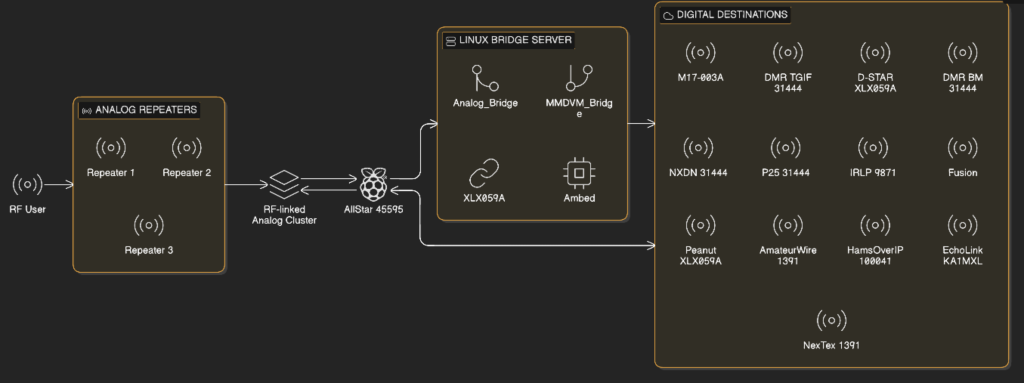
Analog side – how the network flows
On the analog side, RF users come in on any linked repeater on the Quahog network, their audio is collected at a central AllStar hub, and from there it is bridged into the multimode digital and VoIP side of the system.
Step‑by‑step signal path
-
RF user → linked analog repeater cluster
A user keys up on any analog repeater that is part of the RF‑linked Quahog cluster. All of those repeaters are tied together over RF, so a signal into one is heard on the others in the linked group. -
Linked analog repeaters → central AllStar hub (VPS Server)
One repeater in that RF‑linked cluster is interfaced to a Virtual private server running ASL3-AllStar, configured as the central hub node 45595. The repeater’s controller and audio interface feed transmit/receive audio and COR/PTT into the node, so node 45595 “sees” and transmits the full analog audio from the RF network. -
Central AllStar hub → local Linux bridge server
AllStar node 45595 connects over IP to a local Linux bridge server on a different LAN. This bridge host runs:-
Analog_Bridge to translate between AllStar analog audio and AMBE digital vocoder streams.
-
MMDVM_Bridge to present DMR / Fusion / P25 / NXDN “faces” to the digital networks.
-
The local XLXD reflector instance (XLX059A) for D‑STAR / XLX linking.
-
The Ambed dual‑channel AMBE decoder to handle digital audio for multiple modes.
-
-
Bridge server → digital RF systems (two‑way)
From the bridge server, your core multimode link is DMR talkgroup 31444, which is carried on both the BrandMeister and TGIF DMR networks. The same audio is also available on:-
D‑STAR via XLX059A (module A).
-
M17 via reflector M17‑003A.
-
Yaesu Fusion (YSF) 31444 AND 31445.
-
P25 on talkgroup 31444.
-
NXDN on talkgroup 31444.
Analog_Bridge and MMDVM_Bridge encode audio from AllStar 45595 into the correct digital formats for those systems, and decode return audio from those digital systems back into analog for AllStar.
-
-
Bridge server → VoIP and linking networks (two‑way)
The network is also reachable through several VoIP and linking services:-
IRLP node 9871.
-
Peanut app on XLX059A.
-
EchoLink node/call KA1MXL.
-
HamsOverIP extension 100041.
-
AmateurWire extension 1391.
-
NexTec extension 1391 (legacy HamShack Hotline).
Audio from these VoIP paths is mixed in alongside the other digital modes and passed to AllStar 45595 and the RF‑linked analog repeaters, and vice‑versa.
-
-
Return audio back to analog RF
Incoming audio from DMR 31444, XLX059A, M17‑003A, Fusion, P25, NXDN, IRLP 9871, Peanut, EchoLink KA1MXL, HamsOverIP, AmateurWire, and NexTex is decoded on the bridge server. That analog audio is sent back to the AllStar hub node 45595, which keys the RF‑linked analog repeater cluster so analog users hear everything and can talk back into all of those systems.